
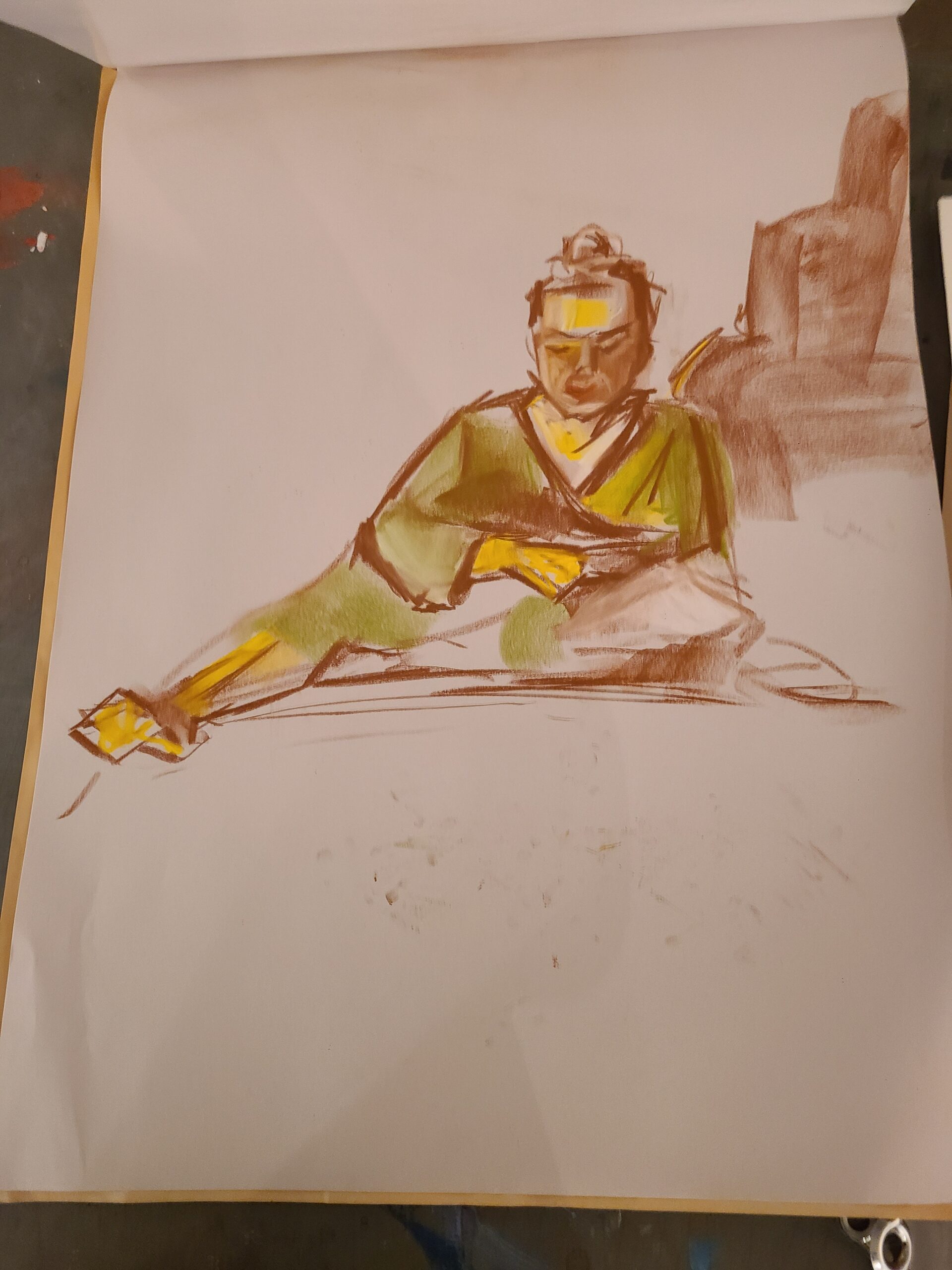
| Human beings do not experience space neutrally; we construct meaning by mapping our bodily existence onto the canvas. Drawing is not a recording of an object, but a mental scaffolding where abstract concepts are given physical weight. |
When I sit down with a blank sheet of paper, I am not stepping into an empty space; I am entering what linguist Per Aage Brandt calls a semiotic domain—a live mental arena where the physical world and human imagination negotiate with one another. We often think of art as a purely visual act, but cognitive semiotics proves it is an architectural one. As George Lakoff and Mark Johnson beautifully demonstrated, our deepest conceptual systems are radically metaphorical and rooted in our bodies. We naturally map our physical spatial realities—up, down, front, back, balance, and weight—onto invisible mental concepts.
In my studio practice, I see this scaffolding materialize through the pencil line. A line is never just a boundary between two shapes; it is a vector of human intention. When I sketch a figure, the geometric guides, the plum lines, and the structural axes left visible on the page are not things that exist in the physical world. They are cognitive scaffolds. They are the structural metaphors we use to understand spatial orientation, gravity, and presence.
When guiding students through life-drawing series, I often observe this translation process in real-time. Students are not just trying to replicate muscles and bone; they are trying to solve what I call the vocabulary problem—the challenge of using a narrow, physical mark to capture a vast, nonverbal internal experience. By leaving my structural guidelines raw and visible in my drawings, I am trying to unmask that invisible architecture. The drawing becomes evidence of how the human mind takes raw, unorganized space and scaffolds it into meaning.