
In my figure drawing series at the MacLaren Art Centre, we’ve been exploring the idea that art is less about “drawing a person” and more about capturing the philosophical tension between opposites. We often discuss how a sad song can feel easier to write because its emotional depth is so palpable; similarly, in visual art, all meaningful information lives in the contrast. We focus on the “bedbug line”—that precise, vibrating boundary where the light meets the dark.
Our journey through this four-part series has been a deliberate deconstruction of perception:
Session 1: The Weight of the Darks
We began with a painterly approach using charcoal. The goal was simple but profound: identify exactly where the darks begin and, more importantly, exactly where they end. By focusing on the shadows first, we define the form through what is hidden, creating a grounded, structural foundation.
Session 2: Carving the Light
In our second session, we flipped the script by working on black paper. Instead of adding shadow, we examined the lights. We looked for the highest points of illumination—where the light hits the skin and where that energy finally dissipates back into the darkness.The images below show that the figure can powerfully emerge from a dark void when you focus strictly on the highlights, using the paper itself to provide the structural shadow.
Session 3: Modeling with Fluidity
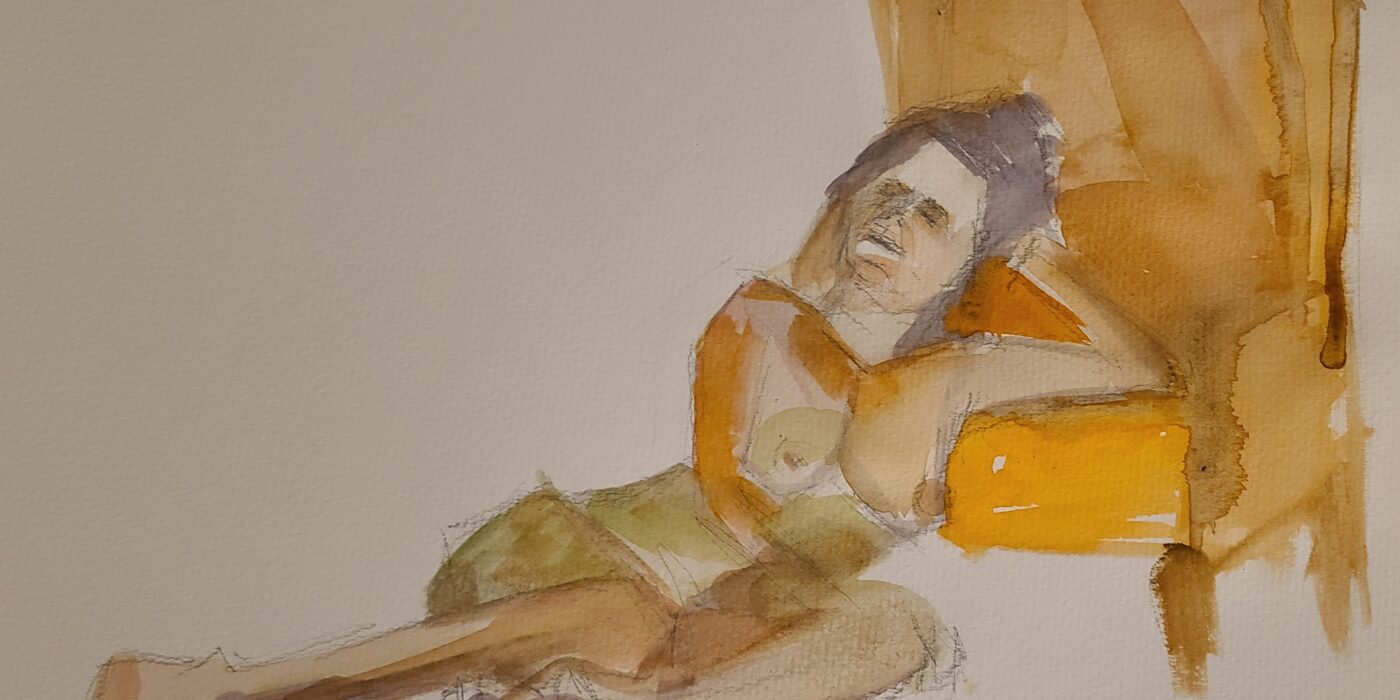
For the third session, we moved into watercolor to revisit the darks. This medium allowed us to “model” the shadows with more nuance and transparency. Using washes of sienna and umber, we explored how dark tones can flow and settle, mimicking the organic curves of the human form.The images below show that using a fluid medium allows for a softer transition between tones, providing a more emotional and “felt” interpretation of the body’s contours.Session 4: The Full SynthesisOur final session will be a full-color study, bringing together every concept we’ve covered. We will integrate the directness of straight lines with the depth of darks and lights, all while playing with the transparencies we discovered through watercolor. It’s the culmination of looking at the figure not just as a subject, but as a study in pure contrast.How has your own perspective on the “bedbug line” shifted as you move from monochrome to full color?