
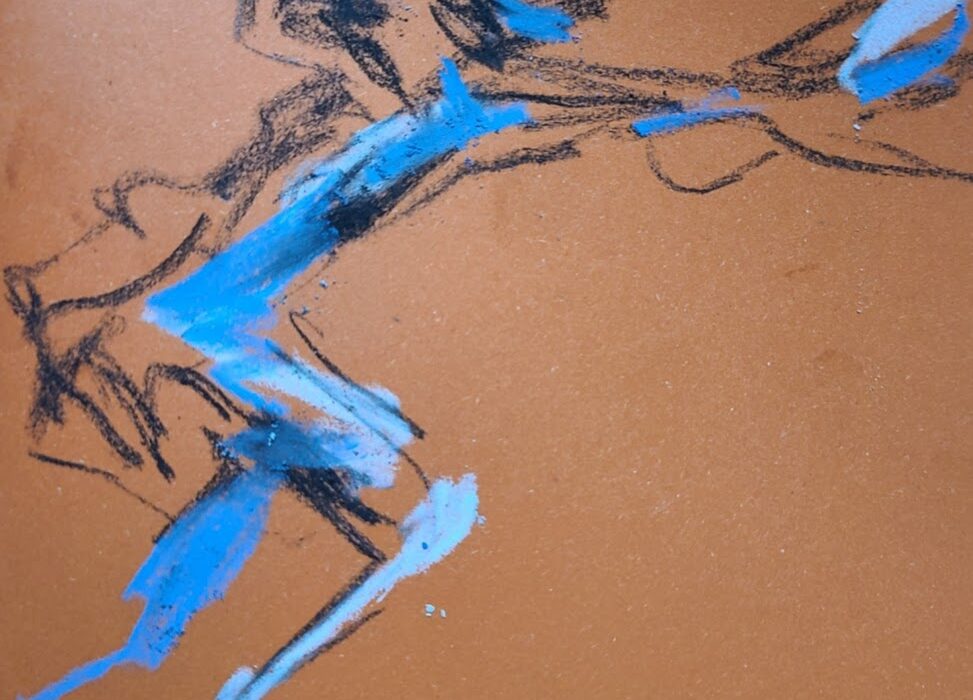
| The brain is fundamentally lazy, seeking to compress raw visual chaos into a clean, simple shorthand. True drawing requires a deliberate dismantling of this ‘Perfect Gestalt’ to rescue the raw sensory experience. |
The human mind operates under a deep psychological drive that visual theorist Rudolf Arnheim explored extensively: the instinctual urge toward the Perfect Gestalt, or the law of simplicity. Our brains are engineered for efficiency. When we look out at the world, we do not see raw variations of light, color, and shifting value; we see pre-packaged concepts. We look at an eye, a hand, or a horizon, and our cognitive shorthand instantly replaces the actual sensory data with a generalized assumption of what should be there.
To practice art is to wage a quiet war against this mental shortcut. It requires entering what philosopher Maurice Merleau-Ponty described as the phenomenological field—the space where we strip away our intellectualized preconceptions and return to the primary, unedited relationship between our body and the world. Merleau-Ponty reminded us that perception is not a passive mirror; it is an active, lived encounter.
When I draw a face or a landscape using raw value planes or negative space, I am deliberately disrupting the ‘Perfect Gestalt.’ By shading only the dark, negative spaces surrounding a subject, or by building a face out of stark, structural blocks of shadow rather than soft, familiar lines, I am forcing the brain’s processing loops to slow down. The image becomes unstable. It refuses to let the viewer’s mind instantly jump to a lazy assumption. In this unstable space, the viewer is forced to stay with the raw sensory signal. This isn’t a technical design trick; it is a rescue mission for our perception, exposing just how much of our daily reality is merely a projection of our expectations.