
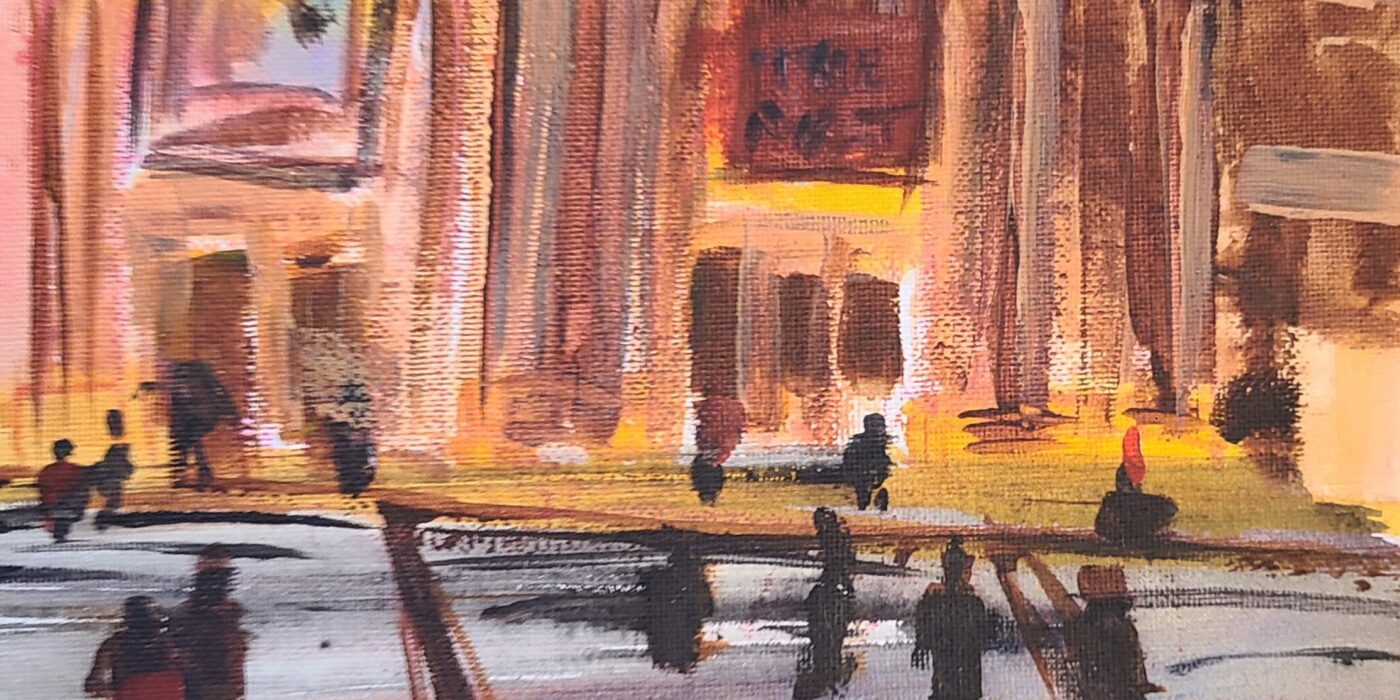
| The boundary between the self and the environment is an illusion of perception. By treating the canvas as an integrated field where subject and background co-create each other, we step past conditional validation into pure participation. |
For a long time, Western artistic and philosophical traditions have been obsessed with isolation. We draw a sharp, hard line around the ‘figure’ and treat the ‘ground’ as mere negative space or background decoration. This visual habit mirrors our cultural identity: we view the individual self as a lonely ego trapped inside a bag of skin, fighting against an external, separate environment.
But as the philosopher Alan Watts frequently pointed out in his regular explorations of Eastern thought, a figure cannot exist without its background. They are not two separate things fighting for dominance; they are a unified field. They co-create each other simultaneously, much like the relationship between buying and selling, or solid and space. The boundary line does not divide the subject from the world; it joins them together.
This relational eye is central to how I run my practice and why I view this platform as a mobile incubator rather than a static gallery storefront. Because my life and studio work move constantly across shifting international borders—from Venice and Vienna to New York and Paris—I had to learn that ‘home’ is not a static coordinate on a map. Home is an expansive, relational field that moves with me.
When I paint figures or landscapes where the paint strokes of the background literally bleed into, texture, and break open the contours of the body, I am practicing this collapse of separation. Creation ceases to be a performative act aimed at conditional, external validation; it becomes a quiet act of pure participation in a pattern larger than the self. When we step onto a stage to speak, into a classroom to teach, or into a studio to paint, we are not separate entities performing for an environment. We are the environment expressing itself.