
| Metaphors are not just literary decorations; they are the fundamental cognitive structures we use to understand our lives. By embedding these bodily metaphors into visual compositions, an artist builds an immediate, nonverbal bridge that resonates directly with the viewer’s subconscious. |
In their groundbreaking cognitive study, Metaphors We Live By, George Lakoff and Mark Johnson proved that metaphor is not merely a poetic device found in language, but the primary scaffolding of human thought. Because our consciousness develops inside a physical body, we naturally map our abstract, internal emotional states onto physical, spatial experiences. We speak of feeling ‘down’ when we are sad, searching for ‘warmth’ in a relationship, or carrying a ‘heavy heart.’ These are conceptual metaphors—they are the way our brains make sense of the invisible by anchoring it to the physical limits and movements of our anatomy.
This cognitive reality is the secret engine behind image creation and consumer resonance. When an artist creates an image that truly moves someone, it is almost always because the visual composition triggers an underlying, deep-seated embodied metaphor.
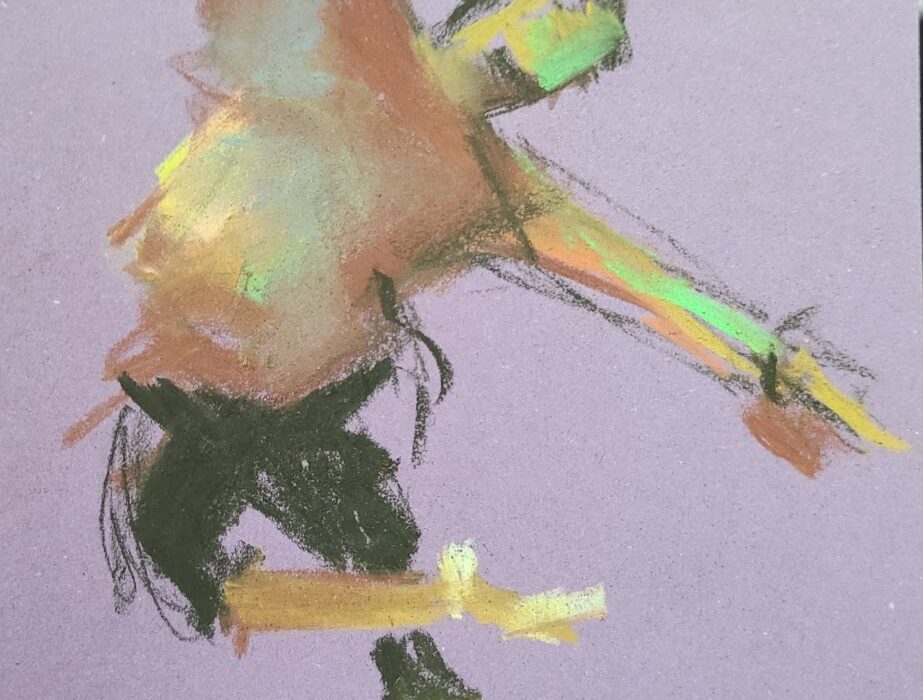
In my own visual practice, particularly in collections focused on body work and figures, I rely heavily on these nonverbal metaphorical channels. When I draw a figure where the posture is heavily compressed, or where the contours are open and bleeding directly into a turbulent, heavily textured background landscape, I am speaking directly to the viewer’s subconscious mapping of Identity and Environment. The viewer does not need an academic degree to understand the image; they feel it instantly because their own body intimately understands what it means to feel compressed by an environment, or to have their internal boundaries blurred by external stress.
By deliberately cropping away or hiding the face in these studies, I prevent the viewer from getting distracted by a specific facial expression, forcing them to engage with the universal, raw metaphor of the body’s posture. This is why certain images resonate so deeply that they cut through the noise of a commercialized world. They don’t require translation. They use the primary, experiential language of the human body to build an approximation bridge—a safe harbor of unconditional connection across the lonely void of our individual minds.