
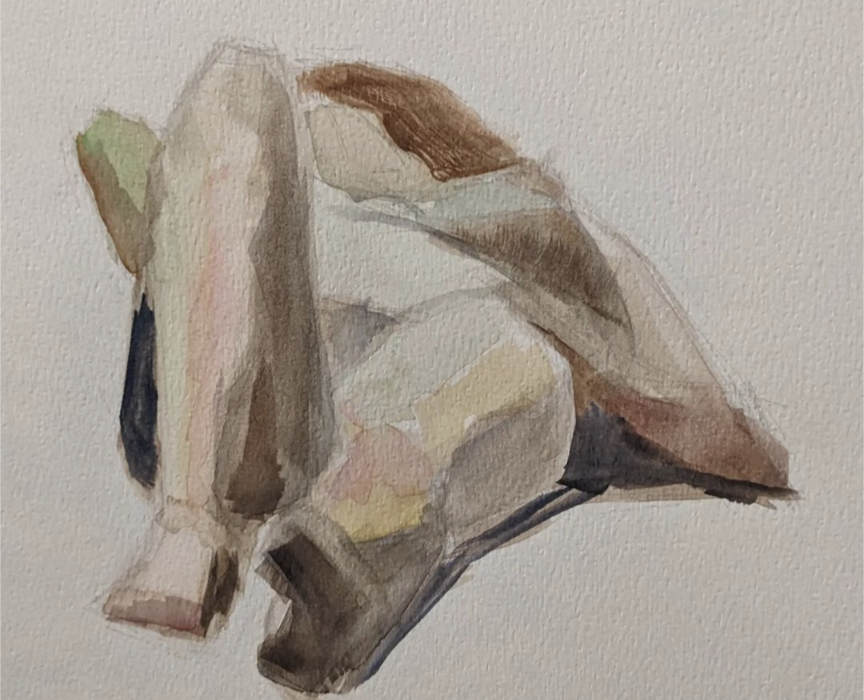
| The human brain is evolutionarily hardwired to find meaningful patterns in random chaos. In the studio, we transform this cognitive glitch into a creative superpower, using the viewer’s instinctual pattern-seeking mind to complete the artwork. |
In evolutionary psychology, researchers use the terms patternicity and apophenia to describe the universal human tendency to find meaningful patterns, shapes, or connections in entirely random, meaningless noise. From a survival standpoint, our minds developed a Hyperactive Agency Detection Device (HADD)—an ancient cognitive mechanism that makes us assume an intentional force is behind a random occurrence (such as hearing a rustle in the leaves and immediately assuming it is a predator rather than the wind). In a modern scientific laboratory, apophenia is often studied as a cognitive bias or an illusion. But inside the art studio, it becomes our greatest vehicle for emotional relatability.
When I paint a contemporary impressionistic figure or landscape, I am intentionally stepping into a dance with the viewer’s apophenia. I don’t render every single leaf on a tree, nor do I perfectly paint every individual knuckle on a hand; instead, I lay down loose gestural brushstrokes, wet washes, and raw textures. I am intentionally leaving the visual field incomplete.
This is where the magic of human connection happens. The moment a consumer looks at an abstract mark and reads it as a shoulder blade or a distant horizon, they are not passively viewing my work; their brain is actively synthesizing it. By relying on pareidolia—the specific sub-type of apophenia where we project human faces and forms into abstract patterns—the art ceases to be a flat object on a gallery wall. It becomes a collaborative space. When I teach life drawing, I encourage students to stop over-rendering and instead trust this pattern-making mind of the viewer. It strips away the pretentious pressure of ‘perfection’ and reminds us that art is a relational game of hide-and-seek, where meaning is beautifully co-created in the space between the canvas and the observer.